The scorecard premium: what is a UFC win worth when the fight was even?
When two UFC fighters perform about equally and the judges split, the one given the win gets about a third more attention afterwards. Across 309 UFC split decisions from 2015 to 2026, the official winner's attention rose 33% more than the loser's when both landed the same share of significant strikes. Out-landing the opponent added little on top of that, and the gap was still open three months after the fight.
We call it the scorecard premium: the attention a fighter gets from the result itself, separate from the performance that produced it.
Why does it matter who gets the attention?
Attention is the currency of sports business. It drives salaries, sponsorships and matchmaking, so how it is shared out decides how athletes are priced.
Economists have two explanations for how it gets shared. Sherwin Rosen (1981) argued that attention tracks talent: small differences in ability turn into large differences in reward, because everyone wants to watch the best. Moshe Adler (1985) argued that attention can attach to an arbitrary early advantage and then compound, because audiences follow what others already follow.
One thing is sure: attention flows to winners. But winners usually performed better, so the attention a win awards and the attention a performance earns have never been separated. Three questions follow. How much of a winner's attention is caused by the official label itself? How much by having performed better? And how does either compare with the attention that comes from putting on an entertaining fight?
The answers decide whether near-equal athletes are priced fairly, and what an official's call is worth.
How do you separate a win from a better performance?
You need fights where performance was even and the result was not. In mixed martial arts, a split decision is exactly that: two judges score the fight for one fighter, one judge scores it for the other. The judges disagreed, so the performances were close to equal, yet the record shows a clean win and a clean loss.
We studied 309 UFC split decisions from 2015 to 2026. For each fighter, we measured the change in public attention from the two months before the fight to the month after it, leaving out fight week. Performance was measured by the winner's share of the significant strikes landed in the fight.
Then we compared the winner's change in attention with the loser's, against how the strikes split. Where the strikes split 50/50, any gap left between winner and loser is the value of the label. How fast the gap grows as the winner lands more is the value of performing better.
We also compared Fight of the Night bouts, the UFC's bonus for the most entertaining fight on a card, with the other decision bouts (1,508 bouts in all), to put a number on entertainment.
How much attention is a win worth on its own?
At equal output, the official winner's attention rose 33% more than the loser's (95% interval: 18% to 49%, p < 0.001).
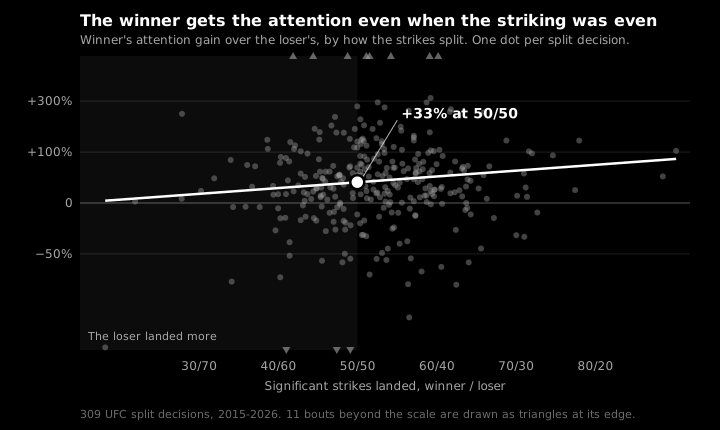
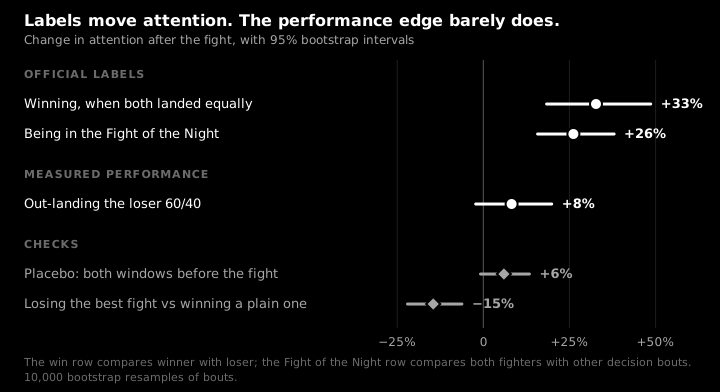
That figure needs one correction. As a check, we ran the same comparison on two windows that both end before the fight, where no gap should exist. It returned +6% (−1% to +13%): small and not statistically clear, but positive, so the fair reading of the premium is net of it. Net of that check, the gap is 25%.
The result held under every robustness check we specified in advance. Adding control time, a measure of grappling dominance, alongside striking did not move it. And the gap does not fade: measured from one to three months after the fight, it was still +35%.
Does landing more strikes earn more attention?
Not much that we could detect. A winner who out-landed the loser 60/40 gained 8% more attention than one who landed the same as the loser (−2% to +20%). That is about a quarter of the label effect, and statistically inconclusive.
In close fights, the official result moves attention far more than the measurable difference in what the fighters did.
Is an entertaining fight worth as much as a win?
Entertainment is worth a lot, but it does not replace the result. Fight of the Night bouts drew 26% more attention for both fighters than other decision bouts (16% to 38%, p < 0.001), close to the size of the win label itself.
But the fighter who lost the Fight of the Night still did worse than a fighter who won an ordinary bout: about 15% less attention (−22% to −6%). Putting on the best fight of the night and losing it is worth less than winning one nobody will remember.
What is a judge's call worth?
In close contests, fame is awarded more than it is earned. One judge's scorecard opens a 25% to 33% gap between two fighters who performed the same, and that gap is still open three months later. A gap that persists instead of fading is the signature of fame that compounds, the way Adler described it, more than the way Rosen did.
Two consequences follow.
Labels can be designed. If an official label creates attention on its own, then belts, rankings and bonuses are attention instruments, and whoever issues credible ones directs attention.
Near-equal athletes are mispriced. Attention is the input to how athletes get paid, and here it separates near-equal fighters by up to a third. That is a mispricing promoters, agents and sponsors can use, and a transfer of value from one fighter to another every time a close call goes the wrong way.
The same test works wherever an official's call separates two near-equal performances: a goal disallowed by VAR, a charge-or-block call in basketball, a reviewed touchdown.
How was the study done?
- Sample. 309 UFC split decisions, 2015 to 2026, with significant-strike counts for both fighters. The Fight of the Night comparison uses 1,508 decision bouts.
- Attention. Each fighter's daily Wikipedia page views, averaged over the two months before the fight and over the month after, leaving out fight week. The outcome is the change between the two, compared on a log scale so that a small name and a large one are measured on the same footing.
- Performance. The winner's share of the significant strikes landed by both fighters. The intercept of the regression at a 50/50 split is the value of the label; its slope is the return to out-landing.
- Pre-registration. All hypotheses were registered on OSF before any post-fight data was accessed: 10.17605/OSF.IO/DXUPH.
- Uncertainty. Every interval is a 95% interval from 10,000 bootstrap resamples of bouts.
Data Credit: First Light Observatory.