Two numbers to check in January 2028
Two predictions for 2027, written down now to be scored in public in January 2028:
- stars will fight less
- the UFC will put on more lopsided matchups
The UFC used to sell what happened before the fight: the personalities, the stakes, the story. It is now moving to selling what happens inside it, the finish you replay and the beating you cannot look away from. Stars are the expensive part of the first model. Two numbers will show how fast the second one is taking over, and we are calling both for 2027.
Stars will fight less. Top-5 fighters have always fought more often than the rest of the roster, between 1.24x and 1.34x as often in every full year since 2021. In 2027 that will fall below 1.20x. It has never happened. In plain terms: a top-5 fighter will fight less than 20% more often than an unranked one.
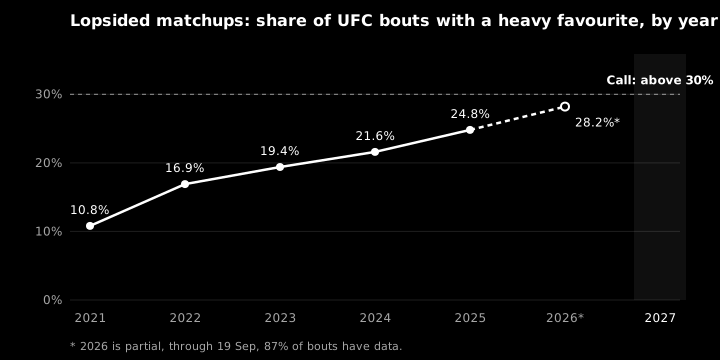
The UFC will put on more lopsided matchups. In more than 30% of 2027 bouts, one fighter will be a heavy favourite, with a 75% or better chance of winning. That has never happened either. In plain terms: nearly one fight in three will be a mismatch on paper.
We will check both in January 2028 and publish the result, right or wrong.
Why this is happening
The business around the UFC has changed, and the way fighters are paid and rewarded has changed with it. Spending and incentives now point the same way, and together they change what the UFC puts in the cage.
- US pay-per-view has ended. Since 2026 every UFC event in the US is on Paramount+, under a seven-year, $7.7B deal, about $1.1B a year. A fighter used to be both a cost line and a revenue line: a star cost more, and also sold more. Now revenue is flat, set by the broadcast deal, so a fighter is only a cost line, and stars suddenly look expensive.
- The UFC is run more like a regular business. Since 2023 it has sat inside TKO, a public company, and Endeavor, which owns most of TKO, was taken private by the investment firm Silver Lake in 2025. The UFC's money flows are now incentivised and nudged by parties further from the end product.
What follows from these facts is a change in what gets rewarded. A matchmaker is rewarded for predictable, repeatable entertainment, and is not rewarded for building a card around one famous name. A fighter is rewarded for finishing fights, and is not rewarded for fame. An owner is rewarded for steady margins, and is not rewarded for the upside of a single star.
This shows up in matchmaking, the product itself. Stars fight less often relative to everyone else, and more bouts are lopsided on paper. The UFC is moving from entertainment that depends on expensive stars to entertainment that happens in the cage: the crazy finish, the beatdown. Spending and incentives agree, and the product is changing to match.
Number one: how often stars fight
This is simple activity: how many times a year a top-5 fighter fights, against how many times a fighter outside the top 5 fights. The fights themselves have not gone anywhere. Fans get as many of them as they used to. What has changed is who is in them.
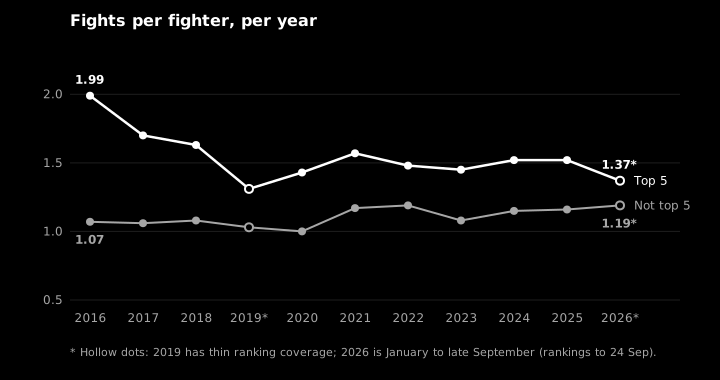
In 2016 a top-5 fighter fought 86% more often than everyone else. In 2026 so far, it is 15% more often. That is a drop of 71 percentage points, or about 38% in how much more often stars fight (a top-5 fighter went from fighting 1.99 times a year to 1.37, a fall of 31%, while everyone else went from 1.07 to 1.19, a rise of 11%).
The product isn't getting worse, but the recipe is changing. A star-based product is built from pre-fight value: the build-up, the personalities, the names you already know, the stakes that have fans tensed up before the fight starts. That kind of value is getting thinner, because the stars appear less often, and less resources are put in promoting their narratives. The entertainment value is moving to the crazy action that happens inside the cage.
The 2026 figures are partial (January to late September, rankings through 24 September), and late-year star cards can lift a full year. That is why this is a call on the full year. In every full year since 2021, a top-5 fighter fought between 1.24x and 1.34x as often as an unranked one. Our call: in 2027, below 1.20x.
Number two: the lopsided fights
A heavy favourite is a fighter with a 75% or better chance of winning. The share of bouts that have one has risen every year since 2021, from 10.8% to 28.2% in 2026 so far (through 19 September), and has never reached 30%. Our call is more than 30% in 2027.
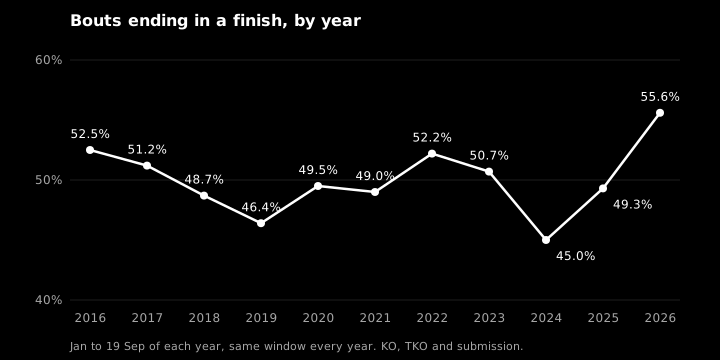
Why it matters: lopsided matchups end in finishes more often. Since 2010, bouts where the favourite is between 50% and 60% have ended in a finish 47% of the time; when the favourite is at 80% or better, it is 65%. In January to 19 September, 49% of bouts ended in a finish across 2016–2025; in 2026 it is 55.6%, the highest of any year since 2010. About half of the rise in the finish rate between 2016–21 and 2025–26 is accounted for by the odds alone.
What the numbers add up to
Three things have moved in the same direction. Stars fight less often relative to everyone else: 86% more often in 2016, 15% more often in 2026. More matchups are lopsided: 28.2% of bouts this year have a heavy favourite, up from 10.8% in 2021. And more fights end in a finish: 65% when the favourite is at 80% or better, against 47% when it is a 50-60% favourite.
Together they point to one change. The UFC is swapping star-based, pre-fight value for fight-action value. It is a different kind of value, not a worse product. We will publish the 2027 figures in January 2028.
What this means for fighters
Fighters have long relied on the UFC's build-ups (the narratives, the hype, the promos, the personalities) to turn them into stars. That out-of-fight value is exactly what the UFC is putting less weight on, as it shifts toward the value created in the cage.
If your goal is to become a star, do not count on the promotion building you up into one, because that's no longer the business they're in. If your goal is to earn off your name, you will be given less opportunities to do it in the cage. Your value is yours to increase, and so is your income beyond the sport.
If you want star economics, you will have to take them into your own hands.
Data Credit: First Light Observatory.